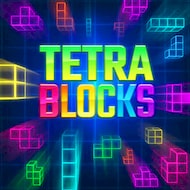
What happens when you’re one Star block away from clearing a line and the next piece drops in the exact wrong shape? That’s the moment Tetra Blocks keeps setting up for you, again and again, until you start planning two pieces ahead instead of one.
| Genre |
Falling-block puzzle |
| Visual style |
Neon-colored blocks |
| Core twist |
Star blocks for bonus scoring |
| Preview |
Next three pieces shown |
| Controls |
Move, rotate, soft drop, hard drop |
Line Clearing and the Star Block Twist
The core loop in Tetra Blocks will feel instantly familiar if you’ve ever stacked falling shapes before: pieces drop, you rotate and slide them into place, and complete horizontal rows disappear. What sets it apart is the Star block variant, where certain pieces carry a glowing star that boosts your score if you manage to clear it as part of a line rather than let it sit buried under later pieces.
Beginners tend to ignore the stars entirely and just play for line clears the way they would in any block game. That works fine for a while, but it leaves real score on the table once the pace picks up and stars start appearing more frequently.
The neon color scheme isn’t just decoration either; on longer sessions, distinguishing piece shapes at a glance by their glow becomes second nature, and players who’ve logged serious time say the colors start to blur into pure shape recognition.
Reading the Next-Piece Preview in Tetra Blocks
- Check the upcoming three pieces before committing your current one, since stacking blind is the fastest way to build an uneven board.
- Prioritize keeping your stack flat rather than tall, especially once you notice a Star block sitting two or three pieces out in the preview queue.
- Save open columns on the edges for long pieces, since Tetra Blocks punishes a cluttered center more than an uneven edge.
- Clear multiple lines at once whenever the board allows it, since stacking several rows before triggering a clear scores higher than clearing one row at a time.
Ignoring the preview queue is the single biggest mistake newer players make, and it’s an easy habit to break once you notice how much cleaner your stack looks when you plan around it.
Difficulty and Pace as Your Level Climbs
Difficulty in Tetra Blocks scales the way most stacking games do: pieces fall faster as your level counter climbs, shrinking your decision window with every stage. Early levels give you time to think through rotations; by the time you’ve cleared enough lines to push into higher levels, hesitation alone can cost you a stack.
Players who’ve pushed into the higher levels talk about a specific point where the drop speed stops feeling manageable through careful thought and starts requiring pure muscle memory on rotation inputs. That transition is where a lot of runs end, and it’s also where the game stops feeling casual and starts feeling genuinely tense.
One thing the community frequently debates: whether the difficulty ramp is too steep too early compared to other block games, or whether that steepness is exactly what keeps runs from dragging on too long. Both takes show up regularly in game discussions.
Advanced Star-Chasing Techniques
Once you’re comfortable with basic line clears, the real skill ceiling in Tetra Blocks is deliberately setting up Star block chains instead of clearing them as they come. Holding a line open for an extra drop or two to line up two star pieces in the same row can multiply your score gain from a single clear, though it risks the stack growing dangerously tall while you wait.
This is a genuine risk-reward decision every serious player has to make. Rush the clear and bank the safe points, or hold the line and gamble on a bigger star combo before the stack overflows.
What is the fastest way to clear multiple lines in Tetra Blocks? Stack pieces flat across the full width of the board and hold off clearing until you can drop a line-piece straight down through multiple completed rows at once, triggering several clears in a single move rather than one row at a time.
- How do the Star blocks affect scoring in Tetra Blocks? Clearing a line that contains a Star block awards bonus points on top of the standard line-clear score, and chaining multiple star clears in close succession compounds the bonus further.
- Why does Tetra Blocks get harder so quickly? The drop speed increases with each level you reach, shrinking your reaction window for rotating and placing pieces, which is why runs that felt relaxed early on can suddenly demand much faster decisions.
- Can you see upcoming pieces in Tetra Blocks? Yes, the interface shows the next three pieces in queue, which experienced players use to plan placement several moves ahead rather than reacting to each piece individually.
Tetra Blocks keeps its identity simple on the surface, but chasing Star block chains while the level counter climbs turns a familiar stacking formula into something with real tension. Once you start holding lines open on purpose instead of clearing on reflex, you’ll understand why the community treats star-chasing as the real skill test underneath the neon glow.