What actually happens the moment you clip a barrier at full speed in Hover Racer Drive? The hovercraft does not gently slow down or bounce off politely — your run simply ends, credits and distance locked in, and you are staring at a restart button wondering if you should have banked left half a second sooner. That question, asked by nearly every new player within their first thirty seconds, gets at exactly what this game is built around.
| Genre |
Endless futuristic racer |
| Platforms |
Browser and mobile |
| Player vehicle |
Hovercraft |
| Goal |
Travel as far as possible without crashing |
| Core mechanic |
Lane weaving, hoop collection, credit-based upgrades |
The Core Loop Behind Hover Racer Drive
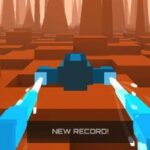
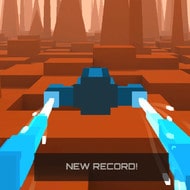
Hover Racer Drive strips racing down to a single, repeatable question: how far can you go before a mistake ends the run? There is no finish line to cross and no opponents to overtake directly. Instead, a computer-generated track scrolls endlessly beneath your hovercraft, throwing barriers, gaps, and tight lane shifts at you with increasing frequency the longer you survive.
The controls stay simple throughout — steer left or right, hold a boost when the track allows it — but the game leans entirely on how well you read what is coming, not on memorized combos or complex inputs.
What keeps the loop from feeling repetitive is the way speed compounds with distance. A section that felt manageable at the start of a run becomes genuinely tense once your hovercraft has been accelerating for two straight minutes.
Colored Hoops and Why They Matter More Than Score
Scattered across every track are colored hoops that grant points and small speed bonuses when you fly through them cleanly. New players often ignore them entirely in favor of playing safe down the center lane, but that caution actually costs progress in Hover Racer Drive, since hoops feed directly into the credits used to unlock better hovercrafts.
Chasing every hoop on a track is also a common way players push themselves into trouble, since the ideal hoop line rarely matches the safest obstacle line. Balancing the two is most of the skill ceiling here.
Credits, Upgrades, and Building a Faster Hovercraft
Credits earned mid-run carry over and can be spent on upgraded hovercrafts once you return to the menu. Better craft generally offer tighter turning or higher top speed, which changes how aggressively you can weave through late-game obstacle density. Community discussion around Hover Racer Drive tends to focus heavily on which craft feels most controllable at high speed, since raw top speed without matching handling often makes a run harder, not easier.
One thing worth noting honestly: the default hovercraft is noticeably harder to control past the first difficulty spike, and several players on forums have pointed out that the early credit grind can feel slow before the handling upgrades start paying off.
How Difficulty Escalates the Longer You Survive
Early into any run, obstacles appear with generous spacing and the track rarely demands more than a single lane shift at a time. Once your hovercraft passes roughly the first minute of sustained flight, the game starts stacking obstacles closer together and narrowing the safe paths between them. By the time a run reaches its later stretch, you are reacting to barrier clusters with almost no room for a delayed decision.
This is the point where most runs actually end, not at the very start.
Reflex Players Versus Route Planners
Two distinct approaches show up constantly among Hover Racer Drive players. Reflex-focused players lean on fast reaction time and tend to favor twitchy last-second dodges, which works well until the track speed outpaces their reaction window. Route-planning players instead try to read two or three obstacles ahead and commit to a lane early, sacrificing a few hoops for consistency. Neither approach is strictly better, but route planners tend to post longer average distances over time.
What Beginners Consistently Misjudge
New players almost always overestimate how much the hovercraft can turn within a single lane, clipping barrier edges they assumed they had cleared. The floating physics behind the hovercraft also surprise people used to grounded racing games, since momentum carries through turns rather than snapping the vehicle instantly to a new direction.
Advanced Techniques Regular Players Rely On
Experienced players in Hover Racer Drive tend to hold boost through hoop clusters rather than after them, using the temporary speed bonus from hoops to chain directly into the next boost window. Drifting through tighter gaps at reduced speed, rather than attempting them at full boost, is another technique that shows up repeatedly in community advice, since a slightly slower clean pass beats a fast collision every time.
How long is an average Hover Racer Drive run?
There is no fixed run length since the track is endless, but most casual players report crashing somewhere in the first two to three minutes, while consistent players who route-plan can extend runs considerably longer.
What do the colored hoops actually do in Hover Racer Drive?
Flying through a colored hoop grants score and a short speed bonus, and the credits earned from them are what unlock upgraded hovercrafts with better handling or top speed.
Is the default hovercraft in Hover Racer Drive good enough to progress?
It works for learning the basics, but its handling becomes a real limitation once tracks narrow and obstacle density increases, which is why most regular players prioritize an early handling upgrade over a speed upgrade.
Hover Racer Drive never pretends to be more than what it is — a fast, unforgiving test of lane reading dressed up in neon and hoops — but that honesty is exactly why players keep coming back to beat their own distance instead of chasing a story or an ending. Whether you are hunting hoops for credits or just trying to survive the next barrier cluster, the hovercraft only rewards the players willing to read the track instead of fighting it.