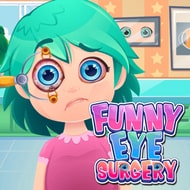
Funny Eye Surgery looks like a lighthearted dress-up game with cartoon patients and bright colors, but it plays like a short, procedural checklist that punishes skipped steps just as much as any stricter simulation would.
| Genre |
Medical simulation |
| Setting |
Eye clinic |
| Patients |
Luke and Lora |
| Core steps |
Cleaning, vision test, cataract treatment, styling |
| Controls |
Mouse click, drag, and drop |
Meeting Luke and Lora
Every session in Funny Eye Surgery starts the same way: Luke and Lora arrive with tired, irritated eyes after too much screen time, and it’s your job to work through their symptoms one procedure at a time. The two patients aren’t interchangeable set dressing; each has slightly different issues to address, which means paying attention to what’s actually visible on their eyes before grabbing a tool.
Newer players tend to rush straight to the fun cosmetic steps at the end, skipping ahead before the underlying issue is actually cleared. That approach usually gets flagged by the game before you can move on, which is a quick way to learn that order matters here.
Kids playing casually tend to treat the whole sequence as a costume party with a doctor theme, while players who enjoy simulation games specifically tend to slow down and treat each step as a real procedure worth doing correctly.
Clearing Germs and Boogers with Eyedrops
The first real procedure is cleaning: eyedrops are used to flush out the germs and boogers built up around Luke and Lora’s eyes before anything else can happen. It’s a small, repetitive step, but skipping it or rushing through it tends to leave visible residue that carries over into later stages.
This opening cleaning phase is also where the game teaches its click-and-drag rhythm. Once you’ve got the eyedrop motion down, the rest of the tool interactions in Funny Eye Surgery follow a similar logic, so this first procedure functions as a soft tutorial even though nothing labels it that way.
Running the Vision Test
After the eyes are clean, the vision test checks how well Luke or Lora can actually see, setting up whether glasses or further treatment come next. This step is short but easy to misjudge if you move through it too quickly, since the feedback isn’t always obvious on a first playthrough.
Community discussion around this stage tends to focus on how satisfying the sequence feels once you know what to look for, compared to how confusing it can be the very first time you encounter it without any prior run.
Players who’ve been through the full clinic loop a few times start recognizing the vision test almost immediately by its layout, which speeds up repeat sessions considerably.
Cataract Treatment and Corrective Care
For patients with more serious symptoms, Funny Eye Surgery introduces a cataract treatment step, a more involved procedure than the earlier cleaning or testing stages. This is the part of the game most often cited as the highlight, since it carries more weight than the cosmetic steps that follow and gives the clinic setting some actual stakes.
Some players find this stage the most engaging part of the whole loop precisely because it feels like a real procedure rather than a styling minigame. Others find it the most repetitive part of a session that otherwise moves quickly, and that split shows up often in how people talk about the game.
Once cataract treatment is complete, Luke or Lora’s eyes are ready for the corrective and cosmetic steps that close out the visit.
Glasses, Stickers, and Sending Patients Home
The final stretch is where Funny Eye Surgery leans fully into its lighter identity: picking out glasses, adding stickers, and topping off the look with a hat before sending Luke or Lora back out the door. None of this affects the medical outcome, but it’s the payoff step most players remember after finishing a full clinic visit.
A specific detail players notice on repeat visits is how differently the same glasses frame can look depending on which patient you’re dressing, since Luke and Lora aren’t styled identically even with matching accessories.
Order of Operations Beginners Get Wrong
The most common early mistake is treating the clinic steps as optional flavor rather than a required sequence. Cleaning has to happen before the vision test registers properly, and the vision test needs to be complete before cataract treatment becomes available. Jumping ahead doesn’t break the game, but it does create a frustrating loop of being sent back to an earlier step.
Once you’ve run through the full sequence with both Luke and Lora a couple of times, the order stops feeling like a rulebook and starts feeling like muscle memory, the same way any short procedural loop does with repetition.
What the Clinic Setting Gets Right and Wrong
The clinic setting in Funny Eye Surgery works well as a framing device precisely because it’s simple: two patients, one small set of tools, a clear beginning and end. Where the community pushes back is on how short a full visit actually is once you know the steps, with some players wishing later stages introduced more procedural variety rather than repeating the same structure for both Luke and Lora.
That’s a fair criticism, and it’s one the game doesn’t really try to hide. What it trades in depth it makes up for in a tight, replayable loop that doesn’t overstay its welcome for a quick session.
Click-and-drag precision matters more than speed throughout every stage, since rushed drags on the eyedrop or cataract tools tend to miss their target and force a repeat rather than saving time.
What holds Funny Eye Surgery together isn’t the styling payoff at the end, it’s the small procedural rhythm that starts with eyedrops and ends with a hat, repeated across two patients who each demand a slightly different read on their symptoms. Once you’ve cleared Lora’s cataract treatment and sent Luke home in his new glasses, the appeal of the format becomes obvious: short, structured, and satisfying precisely because nothing about the sequence is optional.