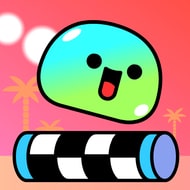
In Blumgi Slime you start with exactly one move: hold to charge, release to jump. No walking, no running, no second option, and that single constraint shapes everything about how the next 150 levels play out.
| Genre |
Arcade platformer |
| Levels |
150 across multiple worlds |
| Core mechanic |
Charge-and-release jump |
| Modes |
Solo and two-player |
| Fail condition |
Falling into water or off the stage |
The Charge-and-Release Jump
The entire skill ceiling of Blumgi Slime lives inside one input: hold down the jump button to charge, and the longer you hold it, the farther your slime launches. Release too early and you’ll fall short of a platform; hold too long and you’ll overshoot into a hazard on the far side. There’s no walking to correct your position mid-air, so every commitment is final the instant you release.
New players consistently undercharge their first several jumps, landing short of platforms they could have cleared easily with a longer hold. That instinct fades fast once a level punishes it a few times in a row.
Kids playing casually tend to enjoy the trial-and-error rhythm of retrying a jump immediately, while players chasing a clean run through all 150 levels treat each charge length as something to memorize precisely.
Sliding Across the Ground in Blumgi Slime
Beyond jumping, your slime has a slide mechanic that lets it zoom across flat ground after landing, which becomes essential once levels start chaining platforms close together. Timing a slide into your next jump charge saves precious seconds and opens up shortcuts that a pure jump-to-jump approach misses entirely.
This is one detail only players who’ve actually spent time in the later worlds tend to notice, since early levels rarely demand it. Once slippery platforms show up, sliding stops being optional and starts being the only way to maintain control.
Reading Moving Platforms and Bounce Pads
Later stages introduce moving platforms, bounce pads, and giant bouncy balls, each of which changes the math behind your charge timing. A moving platform means you’re not just aiming at a fixed point but predicting where that point will be when your slime lands. Bounce pads add extra height on top of your charge, which can send an overcharged jump straight into a hazard above.
Early in the game these obstacles appear one at a time, giving you room to learn each in isolation. By the time you reach the later worlds, several obstacle types stack together in the same stretch, and misreading any one of them usually ends the attempt.
One moment players in the community bring up constantly is the first level that combines a moving platform with a bounce pad, since it’s the point where the game stops feeling like a tutorial and starts feeling like a real test.
Portals and Slippery Floors
Portals appear in select levels and reposition your slime instantly mid-run, which throws off charge timing if you’re not expecting the teleport. Slippery floors, meanwhile, reduce your control on landing, making the slide mechanic riskier to lean on than it would be on solid ground.
These two obstacle types are frequently cited as the most divisive additions in Blumgi Slime. Some players enjoy the extra layer of unpredictability they bring to otherwise familiar platforming; others feel portals in particular break the timing-based rhythm the rest of the game is built around.
Reaching the Checkered Finish Platform
Every level in Blumgi Slime ends the same way: land safely on the checkered finish platform. It sounds simple stated plainly, but the approach to that final platform is usually where a level’s hardest jump sits, forcing you to combine everything you’ve learned about charge length, sliding, and obstacle timing into one last commitment.
Falling into water at any point fails the attempt outright and sends you back to retry, which keeps runs short and restarts nearly instant. That quick-restart design is one of the more praised aspects of the game across player discussion.
Two-Player Mode
- Player one uses one designated key to charge and release jumps, while player two uses a separate key, letting both slimes move independently on the same screen.
- Coordinating jump timing with a second player adds a layer of shared risk that solo play doesn’t have, since a mistimed jump from either player can end the shared attempt.
- Two-player mode tends to appeal most to kids playing alongside a parent or sibling, turning the same 150 levels into a cooperative challenge rather than a solo skill run.
How do you jump farther in Blumgi Slime?
Hold the jump control longer before releasing to charge a farther leap. Precision matters more than raw distance, though, since overcharging past a target platform sends your slime straight into a hazard on the other side.
What happens if you fall in Blumgi Slime?
Falling into water or off the stage fails the attempt immediately and restarts the level from the beginning, though restarts are nearly instant, so a failed jump rarely costs much time.
Is there a way to play Blumgi Slime with another person?
Yes, a two-player mode lets a second slime join using a separate control key, so two people can attempt the same level together on one screen.
Whether you’re threading a single charged jump past a bounce pad or coordinating two slimes through the same level in two-player mode, Blumgi Slime keeps its entire challenge inside that one charge-and-release input. Sticking the landing on the checkered finish platform after a stretch of moving platforms and slippery floors is still the moment the whole game is built around.