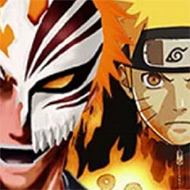
Bleach Vs Naruto 5.0 looks like a nostalgia grab built from two anime openings stitched together, but it plays like a genuine 2D fighter with combo timing, meter management, and a roster deep enough that most players never see every character in a single sitting.
| Genre |
2D fighting, crossover |
| Roster |
48 main fighters, 35 summon characters |
| Modes |
Arcade, Versus, Training, Team Battle |
| Franchises |
Bleach, Naruto |
A Roster Big Enough That Bleach Vs Naruto 5.0 Rewards Specialization
Forty-eight main characters is a lot to sort through, and Bleach Vs Naruto 5.0 doesn’t push you toward any of them — Ichigo and Naruto sit next to far less obvious picks like Urahara and Shikamaru, each with their own attack strings and special-move inputs pulled from moments in either show. New players gravitate toward the recognizable leads first and only branch out once they realize some of the supporting cast counters those leads directly.
Thirty-five additional summon characters sit on top of the main roster, called in as backup during a match rather than played directly, which adds a second layer of team planning most newcomers skip entirely on their first few runs.
Regulars in the community consistently point out that ignoring summons is the single biggest gap between a beginner’s team and a competitive one.
Learning Special Inputs Instead of Mashing Through Bleach Vs Naruto 5.0
Every fighter has a distinct set of special attacks tied to specific button-and-direction combinations rather than one universal moveset reskinned across characters, which means muscle memory from one fighter barely transfers to the next. Ichigo’s close-range pressure plays nothing like Shikamaru’s shadow-based setups, and treating them the same way is the fastest route to an early loss.
Transformations layer on top of that — several characters have a powered-up state that changes their moveset entirely once triggered, and timing that transformation for the right moment rather than the instant it’s available separates casual play from anyone taking matches seriously.
- Learn one character’s basic combo string before touching their special inputs.
- Practice the transformation trigger in Training Mode until it’s automatic under pressure.
- Pick a second character whose weaknesses your main doesn’t share, for Team Battle.
Why Version 5.0 Plays Noticeably Cleaner Than Earlier Releases
Longtime players consistently describe 5.0 as the most refined version circulating — hitboxes read more honestly, animations transition without the stutter older versions were known for, and overall balance between the Bleach side and the Naruto side of the roster feels closer than it used to. That refinement is exactly why veteran players steer newcomers toward 5.0 specifically instead of earlier numbered releases still floating around various portals.
None of that means the game is fully balanced — certain characters still dominate open lobbies, and which ones depends entirely on who you ask in any given community thread.
Arcade, Versus, Training, and Team Battle Ask for Different Skills
Arcade Mode runs you through a ladder of increasingly aggressive AI opponents and is where most players learn a character’s basic toolkit under mild pressure. Versus Mode strips that away for direct matches against another player, where the specific input timing that barely matters against AI suddenly matters a great deal.
Training Mode is where the roster’s depth actually gets learned — dummy opponents, no time pressure, and enough room to work out a transformation timing before ever risking it in a real match. Team Battle changes the equation again by making your second and third picks matter as much as your main, since a bad matchup can be swapped out mid-fight rather than fought through.
Casual players tend to live in Arcade Mode and never touch Team Battle, while competitive players treat Team Battle as the only mode that actually tests roster knowledge.
Stages That Do More Than Sit in the Background
The stage roster pulls from recognizable locations across both anime, and while none of them have interactive hazards, several have enough vertical space that character-specific aerial specials behave differently than they would on a flatter stage. Players who only ever practice on one stage are often caught off guard the first time a match happens somewhere with more room to maneuver.
- Do I need to know Bleach and Naruto to enjoy the roster? No — movesets are self-explanatory enough to pick up through play, though recognizing a character’s source material helps predict their playstyle faster.
- What’s the fastest way to stop losing to transformation combos? Learn the visual and audio cue that precedes a transformation trigger in Training Mode, since blocking or spacing away during that window is far easier than reacting after it’s already active.
- Is Team Battle worth learning if I only play casually? Yes — even a rough second pick to cover your main’s worst matchup meaningfully raises your win rate against players who only know one character.
Bleach Vs Naruto 5.0 never pretends to be a balanced, competition-grade fighter in the way a boxed retail title would — but between the roster size, the transformation system, and the gap between Arcade Mode comfort and Team Battle discipline, it holds up as something worth actually learning rather than just mashing through once.