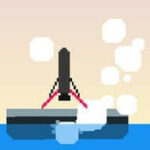
Rocket Pult looks like a simple launch-and-watch toy, but it plays like a physics puzzle where a half-second of mistimed thrust ruins the entire attempt before the rocket even leaves the arm.
Building Momentum on the Launch Arm
Every run starts with the rocket sitting on the catapult arm, and nothing productive happens until you build momentum by thrusting repeatedly before release. Holding the thrust button in one long press produces a weaker swing than a series of timed taps, which is the first thing new players get wrong, since the instinct is to hold rather than pulse the input.
Community vocabulary around this technique calls it the “gentle swing” launch — tapping rather than holding, letting the arm build a rhythm before releasing at the peak of its forward arc. It’s one of the few pieces of advice that consistently separates short early throws from genuinely long ones.
Reading the Fuel Meter Before Committing to a Move
Fuel meter — the resource that governs how much mid-air correction you can afford. Every thrust burst and every use of slow time draws from the same limited pool, so a player who overuses one leaves almost nothing for the other. Watching the meter before deciding whether to correct the rocket’s angle mid-flight, rather than reacting purely to what the trajectory looks like, is what keeps a promising launch from running dry before it lands.
The Release Window That Decides Distance
Release the rocket too early in the swing and it launches at a weak angle; release too late and momentum has already started bleeding off. The window is narrow enough that most beginners miss it consistently for their first several attempts, which is normal — the timing has to be felt rather than calculated on the fly.
Rotating and Steering Once the Rocket Is Airborne
Once launched, the rocket can be rotated clockwise or counter-clockwise mid-flight to correct its path, which matters most when wind or an off-angle launch has already pushed the trajectory somewhere unintended. New players tend to over-rotate, treating steering like a constant correction rather than a small adjustment made once and left alone.
Slow Time and the Trade-Off Every Run Makes
Slowing time gives enough precision to line up a difficult landing or thread a tight gap between obstacles, but it steadily drains the same fuel meter that powers thrust corrections. Using it too early in a run is the most common reason players run out of fuel before reaching a floating bonus target they were aiming for.
This trade-off is genuinely divisive among players. Some treat slow time as an emergency-only tool reserved for landings; others use it constantly and accept the fuel cost as the price of precision. Neither approach is clearly wrong, and which one works better tends to depend on whether a run is being played for distance or for hitting every bonus target along the way.
Landing Legs and the Bonus Points Most Players Skip
Deploying the landing legs just before touchdown converts a crash into a clean landing, and clean landings carry a scoring bonus that many players ignore entirely in favor of chasing raw distance. Timing the deployment too early causes drag that shortens the flight; too late, and the rocket tips on impact and forfeits the bonus anyway.
Floating Targets Over the Water
Scattered floating objects sit on the water’s surface during flight, and hitting them adds a meaningful score bonus on top of distance. Early in a run these targets are close enough to hit almost by accident, but by the time a rocket has traveled far enough to reach the more distant ones, fuel is usually running low, which forces a real decision between conserving fuel for a landing or spending it chasing one more target.
Why Early Attempts Fall Short of a Personal Best
Most first attempts fail for the same reason: players either hold thrust instead of pulsing it, or burn their entire fuel supply correcting a launch angle that didn’t need correcting. Once the gentle swing technique clicks, distance improves dramatically within just a handful of runs, which is why the game feels much harder in the first few minutes than it does an hour in.
The controls themselves are simple — thrust, turn, release, and slow time each map to a single key — but simple controls with a narrow timing window is exactly what makes Rocket Pult feel deceptively difficult compared to how it looks on the first launch.
Rocket Pult never adds new mechanics beyond the catapult, the fuel meter, and the landing legs, and it doesn’t need to — every additional meter of distance comes from getting the same three systems to work together slightly better than the last attempt, which is the whole reason players keep chasing one more launch.