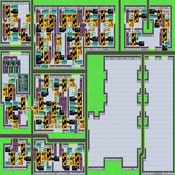
Most auto-battlers let the game play itself and call that a feature. Fortune Mill lets you take the wheel back at any moment, and that single decision changes almost everything about how a run feels. It’s a multi-class survival game where up to six units fight across a screen packed with enemies, and whether you’re watching the fight unfold or steering every hit is entirely up to you.
| Genre |
Multi-class auto-battler survival |
| Party Size |
Up to 6 units per run |
| Classes / Abilities |
6 classes, 36 abilities |
| Passive Tree |
1,000+ nodes |
What Fortune Mill Actually Asks You to Manage
Underneath the auto-battler surface, Fortune Mill is a management game as much as a combat one. You’re deciding how six units divide their attention across hundreds of mobs, which abilities get prioritized, and which of the 50-plus items are worth carrying into the next fight instead of vendoring for gold. The screen gets loud fast, and reading it is a skill in its own right.
New players tend to treat early runs as a formality before the “real” systems kick in, and that instinct is premature more than wrong. Fortune Mill genuinely opens up once you’ve sat with its systems for a while — returning players often describe the first several hours as setup, where the passive tree and gear synergies are still too shallow to show what the game is building toward.
Six Classes, Thirty-Six Abilities, One Screen Full of Chaos
The class roster is small on paper and enormous in practice. Six active classes share a pool of 36 abilities, and because you’re fielding up to six units at once, a run is rarely “one class doing one thing.” It’s closer to assembling a small army, and abilities like Ricochet, Bubble, and Cross Bone behave differently depending on which class is casting them and what’s already on the field.
- Sword Throw and Piercing Orb reward positioning units so their lines connect with mob density instead of empty space.
- Ping Pong Shuriken punishes single-target thinking, since it scales with how clustered the enemies are.
- Shadownova is the kind of ability players build a whole run around once it’s unlocked.
The Centaur Class and Why Players Gravitate Toward It
Among the six classes, the Centaur comes up constantly in player discussion, largely because it straddles the line between a frontline unit and something with real mobility across the packed battlefield. It isn’t handed to you as the obvious best pick — the roster is built for synergy, not one dominant option — but it’s frequently the class new players remember first, since its kit makes the early screen-reading problem more forgiving.
Reading the Passive Tree Before You Dump Nodes Into It
The passive tree is where Fortune Mill quietly becomes a much bigger game than its combat screen suggests. Over 1,000 nodes are available for long-term planning, and its sheer size is one of the more divisive things players bring up — some treat the scale as the whole point, while others find the layout hard to read at a glance and call early planning more confusing than it needed to be. Once you’ve cleared enough runs to see the tree’s shape rather than just its size, planning stops feeling random, and early nodes reinforce whatever your first couple of classes already do well.
Automatic, Manual, or Somewhere Between
- Fully automatic control lets all six units fight on their own, suiting players who want to watch builds interact without managing input.
- Fully manual control hands you direct input, rewarding players who want abilities like Ping Pong Shuriken to land where they’re aimed.
- A mixed mode lets you steer part of the team while the rest auto-battles, where experienced players tend to settle.
The Sell All Mistake Every Fortune Mill Player Makes Once
There’s one error that comes up again and again in player discussion: hitting Sell All on gear early, before understanding how Support abilities interact with equipped items. It looks like harmless cleanup, and it isn’t — clearing gear before you’ve built a sense of what a Support-focused unit needs can quietly gut a run’s mid-game with no warning. Fortune Mill doesn’t stop you from doing it, which is exactly why the mistake is so common.
Crafting Gear and Chasing Boss Rewards Between Runs
Defeating a boss doesn’t just end an encounter, it opens a choice: an ability-altering reward that can reshape the rest of the run. Combined with crafting loot into better gear, this is where the loop stops being about surviving one run and starts being about setting up the next. Players who ignore crafting tend to plateau earlier than those who treat gear as its own layer of strategy.
Is Fortune Mill more of an idle game or an action game?
It’s genuinely both. With fully automatic control engaged, six units and 36 abilities run largely on their own, giving it real idle-game DNA, but manual control turns the same systems into something closer to an action game where positioning and timing decide fights.
How many classes and abilities does Fortune Mill have?
There are 6 active classes, including the Centaur, sharing a combined pool of 36 abilities. Because up to 6 units can be fielded at once, most runs mix multiple classes rather than committing to just one.
What should new players avoid doing early in Fortune Mill?
The most common misstep is hitting Sell All on gear before understanding Support abilities, which can strip a unit of exactly what it needed heading into the mid-game. It’s worth learning what a piece of equipment does before clearing it out to trim inventory clutter.
Fortune Mill rewards the kind of player who keeps coming back to poke at one more branch of the passive tree — between the Centaur’s early appeal, the Sell All trap almost everyone falls into once, and a stats tree with over a thousand nodes to map out, it’s built for long-term tinkering rather than a single satisfying run.